Frequently asked questions
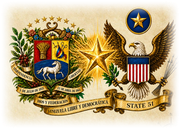
What would it mean for Venezuela to become the 51st state?
Full incorporation into the Union, with citizenship and representation, as the architecture of maximum irreversibility, executable only by Venezuelan decision in referendums.
What are the other paths?
A Free and Democratic Venezuela. The country recovers its institutions and governs itself, with a strategic alliance with the United States but without ceding sovereignty. It is the first aspiration and the one with the greatest historical legitimacy; its risk is relapse, and that is why it is only worth having if it is born irreversible.
Supervised Territoriality. A structural association of transition that provides superior legal frameworks in exchange for sovereignty restricted for a time. It can serve as a bridge, but it threatens to freeze into limbo; that is why the book admits it as a step, never as a destination.
Who decides?
That decision belongs to the people of Venezuela and to the United States Congress. What a book can do is see that it is made with the information on the table.
How does a new state join the United States?
Under the U.S. Constitution, the power to admit new states belongs to Congress, which does so by passing a law by simple majority in both houses.
There are usually five steps: territorial government, enabling act, state constitution, admission act or joint resolution, and presidential proclamation.
Constitution, Art. IV, Sec. 3 (archived copy) · CRS R47747 (archived copy)
Has any state joined this way before?
Texas (1845). Joint resolution of annexation, March 1, 1845; Texans voted on October 13 (7,664 in favor, 430 against); admitted on December 29, 1845.
Alaska (1959). Statehood act of July 7, 1958 (House 210–166, Senate 64–20); local referendum on August 26, 1958 (40,452 in favor, 8,010 against); proclaimed on January 3, 1959.
Hawaii (1959). Admission act of March 18, 1959 (House 323–89, Senate 76–15); plebiscite on June 27, 1959 (132,773 in favor, 7,971 against); proclaimed on August 21, 1959.
What happened with Puerto Rico?
Four recent plebiscites, none of them binding. 2012 (November 6): on the second question, statehood won 61.16% of valid votes, or 44.4% if blank ballots are counted. 2017 (June 11): 97.18% for statehood, on turnout of about 23%, amid an opposition boycott. 2020 (November 3): 52.52% voted yes to immediate admission. 2024 (November 5): 58.61% for statehood, according to results certified on January 17, 2025. The House of Representatives passed the Puerto Rico Status Act (H.R. 8393) on December 15, 2022, by a vote of 233–191; the Senate did not vote on it.
CRS R44721 (archived copy) · Certified 2024 results (archived copy)
Would Venezuela lose its identity?
New Mexico has kept its Hispanic identity and its constitutionally protected Spanish since 1912; Louisiana keeps its civil law two centuries later; Hawaii is still Hawaii.
What dissolves nations is not federalism: it is forced diaspora, the destroyed school, and misery.
Would the United States pay Venezuela’s debt?
Statehood does not federalize the debt.
When Texas entered the Union in 1845, it brought the debt of its decade as a republic—close to ten million dollars of the time, a mountain for its size. The joint resolution of annexation was explicit: Texas kept its debts, which would in no case become a burden on the government of the United States.
The restructuring of the inherited debt must be a precondition resolved—or set on track with a signed agreement—before the Admission Act, not a problem kicked inside.
Why would the other states accept a smaller share of power in Congress?
Relative dilution accompanied each of the thirty-seven admissions after the thirteen colonies, including that of Texas—which entered enormous—and those of Alaska and Hawaii; Congress has granted it whenever the absolute gain exceeded the relative cost.
What has Donald Trump said?
Since March 2026, Donald Trump has floated the idea of Venezuela as the 51st state several times: on Truth Social, on Fox News, and with maps posted in May and in August.
What has Venezuela’s government said?
On May 11, 2026, Delcy Rodríguez rejected the idea: “That would never be contemplated.”
Where is all of this explored in depth?
The first volume poses the question seriously and maps the ground: the three paths, the yardstick by which each one is judged, and the thresholds that would have to be met. The other four volumes take up what is to be done next.